linear_elasticity/rigid_lagrange.py
Description
Linear elasticity example with rigid-body constraints enforced via Lagrange multipliers.
Find  ,
,  ,
,  ,
,
 such that:
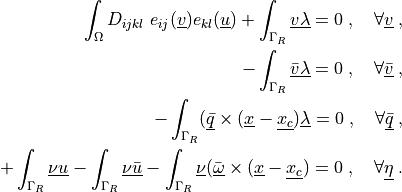
The displacements in the 'Rigid' region are constrained to rigid body
motions. The rigid volume, centered at  , is not present in
the domain’s mesh, the constraint is applied to its surface
, is not present in
the domain’s mesh, the constraint is applied to its surface  .
.
Usage Examples
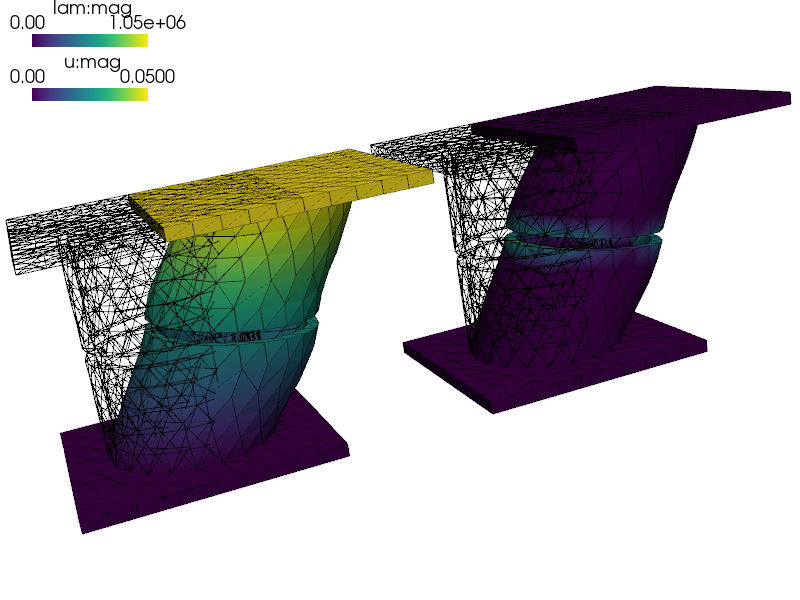
Run with the default parameters, visualize deformation with 10 times magnified displacements:
sfepy-run sfepy/examples/linear_elasticity/rigid_lagrange.py
sfepy-view output/rigid_lagrange/cut-cylinder.*.vtk -f u:wu:f10:p0 1:vw:wu:f10:p0 1:vw:p0
View the Lagrange multipliers
and the rigid body motion
displacements and rotations :sfepy-view output/rigid_lagrange/cut-cylinder.*.vtk -f lam:wu:f10:p0 1:vw:wu:f10:p0 1:vw:p0 sfepy-view output/rigid_lagrange/cut-cylinder.*.vtk -f ub:wu:f10:p0 1:vw:wu:f10:p0 1:vw:p0 sfepy-view output/rigid_lagrange/cut-cylinder.*.vtk -f ob:wu:f10:p0 1:vw:wu:f10:p0 1:vw:p0
Change elasticity parameters and field approximation orders:
sfepy-run sfepy/examples/linear_elasticity/rigid_lagrange.py -d "E=1e9,nu=0.3,order_u=2,order_lam=0"
r"""
Linear elasticity example with rigid-body constraints enforced via Lagrange
multipliers.
Find :math:`\ul{u}`, :math:`\ul{\bar{u}}`, :math:`\ul{\bar{\omega}}`,
:math:`\ul{\lambda}` such that:
.. math::
\int_{\Omega} D_{ijkl}\ e_{ij}(\ul{v}) e_{kl}(\ul{u})
+ \int_{\Gamma_R} \ul{v} \ul{\lambda}
= 0
\;, \quad \forall \ul{v} \;,
- \int_{\Gamma_R} \ul{\bar{v}} \ul{\lambda}
= 0
\;, \quad \forall \ul{\bar{v}} \;,
- \int_{\Gamma_R} (\ul{\bar{q}} \times (\ul{x} - \ul{x_c}) \ul{\lambda}
= 0
\;, \quad \forall \ul{\bar{q}} \;,
+ \int_{\Gamma_R} \ul{\nu} \ul{u}
- \int_{\Gamma_R} \ul{\nu} \ul{\bar{u}}
- \int_{\Gamma_R} \ul{\nu} (\ul{\bar{\omega}} \times (\ul{x} - \ul{x_c})
= 0
\;, \quad \forall \ul{\eta} \;.
The displacements in the ``'Rigid'`` region are constrained to rigid body
motions. The rigid volume, centered at :math:`\ul{x_c}`, is not present in
the domain's mesh, the constraint is applied to its surface :math:`\Gamma_R`.
Usage Examples
--------------
- Run with the default parameters, visualize deformation with 10 times
magnified displacements::
sfepy-run sfepy/examples/linear_elasticity/rigid_lagrange.py
sfepy-view output/rigid_lagrange/cut-cylinder.*.vtk -f u:wu:f10:p0 1:vw:wu:f10:p0 1:vw:p0
- View the Lagrange multipliers :math:`\ul{\lambda}` and the rigid body motion
displacements :math:`\ul{\bar{u}}` and rotations :math:`\ul{\bar{\omega}}`::
sfepy-view output/rigid_lagrange/cut-cylinder.*.vtk -f lam:wu:f10:p0 1:vw:wu:f10:p0 1:vw:p0
sfepy-view output/rigid_lagrange/cut-cylinder.*.vtk -f ub:wu:f10:p0 1:vw:wu:f10:p0 1:vw:p0
sfepy-view output/rigid_lagrange/cut-cylinder.*.vtk -f ob:wu:f10:p0 1:vw:wu:f10:p0 1:vw:p0
- Change elasticity parameters and field approximation orders::
sfepy-run sfepy/examples/linear_elasticity/rigid_lagrange.py -d "E=1e9,nu=0.3,order_u=2,order_lam=0"
"""
from functools import partial
import numpy as nm
from sfepy import data_dir
from sfepy.linalg import make_cross_matrices
from sfepy.mechanics.matcoefs import stiffness_from_youngpoisson
def get_pars(ts, coors, mode=None, rigid_centre=None, **kwargs):
if mode == 'qp':
mtxs = make_cross_matrices(coors - rigid_centre[None, :], first=False)
return dict(C=mtxs)
def define(
E=5e6,
nu=0.45,
move='x',
shift=0.05,
order_u=1,
order_lam=1,
refine=0,
solver='auto',
output_dir='output/rigid_lagrange',
**kwargs,
):
filename_mesh = data_dir + '/meshes/3d/cut-cylinder.vtk'
rigid_centre = nm.array([0.0, 0.0, 0.0], dtype=nm.float64)
cm, cs = -0.025, 0.025
eps = 1e-8
cm0, cm1 = cm - eps, cm + eps
cs0, cs1 = cs - eps, cs + eps
centre = [0, 0, 0]
c = 'z'
options = {
'nls' : 'newton',
'ls' : solver,
'refinement_level' : refine,
'output_dir': output_dir,
'eterm': {
'verbosity' : 0,
'backend_args' : {
'backend' : 'numpy',
'optimize' : True,
'layout' : None,
},
},
}
regions = {
'Omega' : 'all',
'Bottom' : (f'vertices in ({c} < -0.499999)', 'facet'),
'Top' : (f'vertices in ({c} > 0.499999)', 'facet'),
'RigidM' : (f'vertices in ({c} > {cm0}) & ({c} < {cm1})', 'facet'),
'RigidS' : (f'vertices in ({c} > {cs0}) & ({c} < {cs1})', 'facet'),
'Rigid' : ('r.RigidM +s r.RigidS', 'facet'),
}
fields = {
'fu' : ('real', 'vector', 'Omega', order_u),
'flag' : ('real', 'vector', 'Rigid', order_lam),
'frig' : ('real', 'vector', 'Rigid', 0, 'L2', 'constant'),
}
variables = {
'u' : ('unknown field', 'fu', 0),
'v' : ('test field', 'fu', 'u'),
'ub' : ('unknown field', 'frig', 1),
'vb' : ('test field', 'frig', 'ub'),
'ob' : ('unknown field', 'frig', 2),
'qb' : ('test field', 'frig', 'ob'),
'lam' : ('unknown field', 'flag', 3),
'nu' : ('test field', 'flag', 'lam'),
}
materials = {
'm' : ({
'D' : stiffness_from_youngpoisson(3, young=E, poisson=nu),
},),
'r' : 'get_pars',
}
ebcs = {
'bottom': ('Bottom', {'u.all': 0.0}),
'top': ('Top', {'u.all': 'move_top'}),
}
def move_top(ts, coors, bc, problem, **kwargs):
val = nm.zeros_like(coors)
ic = dict(x=0, y=1, z=2)[move]
val[:, ic] = ts.nt * shift
return val
functions = {
'move_top' : (move_top,),
'get_pars' : (partial(get_pars, rigid_centre=rigid_centre),),
}
integrals = {
'i': 2 * max(order_u, order_lam),
}
equations = {
'eq1' :
"""
+ dw_lin_elastic.i.Omega(m.D, v, u)
+ de_dot.i.Rigid(v, lam)
= 0
""",
'eq2' :
"""
- de_dot.i.Rigid(vb, lam)
= 0
""",
'eq3' :
"""
- de_dot.i.Rigid(r.C, qb, lam)
= 0
""",
'eq4' :
"""
+ de_dot.i.Rigid(nu, u)
- de_dot.i.Rigid(nu, ub)
- de_dot.i.Rigid(r.C, nu, ob)
= 0
""",
}
solvers = {
'pypardiso': ('ls.pypardiso', {}),
'auto': ('ls.auto_direct', {
'use_presolve' : True,
'memory_relaxation' : 50,
}),
'newton' : ('nls.newton', {
'i_max' : 1,
'eps_a' : 1e-8,
'lin_red' : None,
'report_status' : True,
'is_linear' : True,
}),
'ts' : ('ts.simple', {
't0' : 0.0,
't1' : 1.0,
'dt' : None,
'n_step' : 5,
'quasistatic' : True,
'verbose' : 1,
}),
}
return locals()