diffusion/poisson_nonlinear_parametric.py
Description
Nonlinear diffusion with a field-dependent coefficient and parametric sweep.
Solve the problem:

with homogeneous Dirichlet boundary conditions:

The diffusion coefficient depends on the solution:

The problem is solved for several values of  , and the
solutions are compared to the linear case
, and the
solutions are compared to the linear case  .
.
Usage Examples
Run with the default parameters:
sfepy-run sfepy/examples/diffusion/poisson_nonlinear_parametric.py
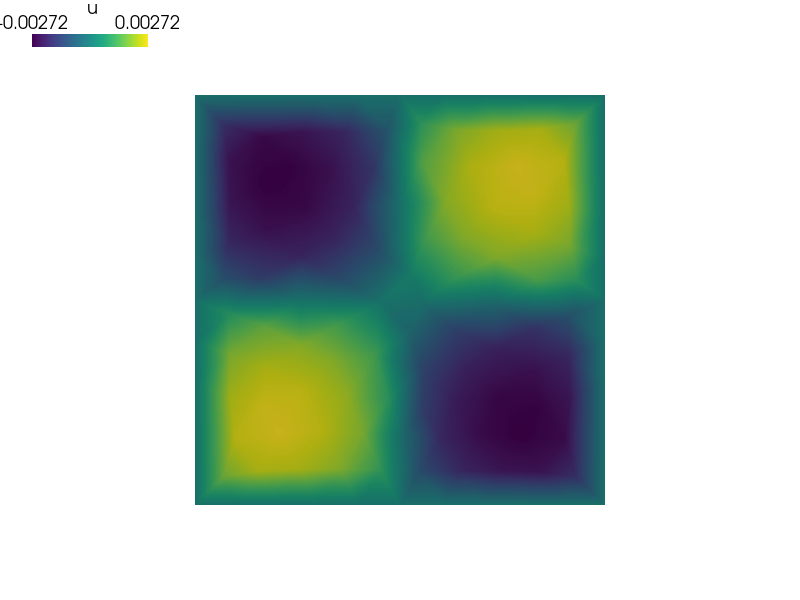
sfepy-view output/poisson_nonlinear_parametric/square_unit_tri_alpha_*.vtk -2
Use custom values of
, show  :
:sfepy-run sfepy/examples/diffusion/poisson_nonlinear_parametric.py -d "alphas=[1e5,5e5,1e6]" sfepy-view output/poisson_nonlinear_parametric/square_unit_tri_alpha_*.vtk -2 -f u:gu:p0 u:p0 --no-scalar-bars
r"""
Nonlinear diffusion with a field-dependent coefficient and parametric sweep.
Solve the problem:
.. math::
-\nabla \cdot \left( (1 + \alpha u^2)\nabla u \right)
= \sin(\pi x)\sin(\pi y)
\quad \text{in } \Omega,
with homogeneous Dirichlet boundary conditions:
.. math::
u = 0 \quad \text{on } \partial \Omega.
The diffusion coefficient depends on the solution:
.. math::
c(u) = 1 + \alpha u^2.
The problem is solved for several values of :math:`\alpha`, and the
solutions are compared to the linear case :math:`\alpha = 0`.
Usage Examples
--------------
- Run with the default parameters::
sfepy-run sfepy/examples/diffusion/poisson_nonlinear_parametric.py
sfepy-view output/poisson_nonlinear_parametric/square_unit_tri_alpha_*.vtk -2
- Use custom values of :math:`\alpha`, show :math:`\nabla u`::
sfepy-run sfepy/examples/diffusion/poisson_nonlinear_parametric.py -d "alphas=[1e5,5e5,1e6]"
sfepy-view output/poisson_nonlinear_parametric/square_unit_tri_alpha_*.vtk -2 -f u:gu:p0 u:p0 --no-scalar-bars
"""
from sfepy import data_dir
from sfepy.base.base import output
import numpy as nm
def define(alphas=None, order=1, qp_order=4, i_max=20,
output_dir='output/poisson_nonlinear_parametric'):
filename_mesh = data_dir + '/meshes/2d/square_unit_tri.mesh'
if alphas is None:
alphas = [0, 1000, 10000, 100000, 1000000]
_state = {'alpha': 0.0}
def conductivity(u):
val = 1.0 + _state['alpha'] * u**2
return val
def d_conductivity(u):
# derivative of (1 + alpha * u^2) w.r.t. u
return 2.0 * _state['alpha'] * u
def get_rhs(ts, coors, mode=None, **kwargs):
if mode == 'qp':
x = coors[:, 0]
y = coors[:, 1]
val = nm.sin(nm.pi * x) * nm.sin(nm.pi * y)
val = val.reshape((-1, 1, 1))
return {'val': val}
def vary_alpha(problem):
baseline = None
ofn_trunk = problem.ofn_trunk
output_format = problem.output_format
output_dir = problem.output_dir
# Newton handles the nonlinearity; we just sweep alpha values
for alpha in alphas:
_state['alpha'] = alpha
alpha_tag = f'{alpha:010.2f}'.replace('.', '_')
problem.setup_output(
output_filename_trunk=ofn_trunk + '_alpha_' + alpha_tag,
output_dir=output_dir,
output_format=output_format,
)
yield problem, []
vec = problem.get_variables()['u']().copy()
if baseline is None:
baseline = vec.copy()
diff_norm = nm.linalg.norm(vec - baseline)
sol_norm = nm.linalg.norm(vec)
output('---')
output('alpha:', alpha, '||u||:', sol_norm, '||u - u0||:', diff_norm)
yield
materials = {
'rhs': 'get_rhs',
}
fields = {
'fu': ('real', 1, 'Omega', order),
}
variables = {
'u': ('unknown field', 'fu', 0),
'v': ('test field', 'fu', 'u'),
}
regions = {
'Omega': 'all',
'Gamma': ('vertices of surface', 'facet'),
}
ebcs = {
'u0': ('Gamma', {'u.0': 0.0}),
}
functions = {
'get_rhs': (get_rhs,),
'conductivity': (conductivity,),
'd_conductivity': (d_conductivity,),
}
integrals = {
'i': qp_order,
}
equations = {
'Balance': """
dw_nl_diffusion.i.Omega( conductivity, d_conductivity, v, u )
= dw_volume_lvf.i.Omega( rhs.val, v )
"""
}
solvers = {
'ls': ('ls.scipy_direct', {}),
'newton': ('nls.newton', {
'i_max': i_max,
'eps_a': 1e-10,
'eps_r': 1.0,
}),
}
options = {
'nls': 'newton',
'ls': 'ls',
'parametric_hook': 'vary_alpha',
'output_dir': output_dir,
}
return locals()